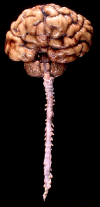
Click on this icon to see the frontal view.
NQ-050
Answer:
(B) Alobar holoprosencephaly
Diagnosis:
(B) Alobar holoprosencephaly
Pathology of the cases:
Frontal view:
On the frontal view, the two cerebral hemispheres appear to be fused in the
midline although there is a falx like structure at the midline. In contrast,
the cerebellum and the medulla seems to have split well into the right and
left half.
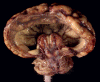
Occipital View: The cerebral hemispheres shows that the
occipital portion is reduced to a thin translucent seam
(white arrow). This is best
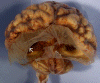
illustrated in the image with the specimen submerged under water. The
occipital portion of the parietal and occipital pallium is entirely
converted into a thin membrane. The thalamus and the basal ganglia appear to
have split into the left and right half. There is a single,
dilated ventricle with no septum pellucidum.
Occipital
Glial-ependymal Seam: As only the frontal half of the telencephalon exists,
it would appear as like a shield on lateral view and this type of
holoprosencephaly is also called the shield type holoprosencephaly
[click here to see an MRI online].
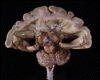
Continuation of gray matter across midline: On a coronal
cut, the gray matter cross over the midline and no corpus callosum is
present and, again, no septum pellucidum is found. Continuation of gray
matter across the midline and a lack of septum pellucidum are two hall mark
features that can aid in easily recognizing lobar or semilobar
holoprosencephaly.
|
|
Click on this icon to see the frontal view. |
|
|
Click on this icon to see the occipital view. The seam is highlighted by the arrow. |
|
|
Click on this icon to see the submerged occipital view. The glial ependymal seam is highlighted by the arrow. |
|
|
Click on this icon to see the occipital view with a coronal cut. Note the continuation of gray matter across the midline and the lack of a septum pellucidum. |
De Morsier Syndrome (Septo-optic dysplasia)
is characterized by optic nerve hypoplasia, aplasia or defects of the septum
pellucidum (an inconstant finding), and pituitary-hypothalamic dysfunction
(hypopituitarism). Two of the three features must be present to fulfill the
diagnostic criteria and only a minor portion of cases have all three
features. The floor of third ventricle, a structure embryonically related to
the development of the optic placodes, is abnormal in some cases. Olfactory
aplasia is frequent. Other features include elevation of the tentorium
cerebelli and lateral and transverse sinuses and torcula, lack of patency of
the foramina of Magendie and Luschka, and hydrocephalus. Not all these
features are present in every case. Although the septum pellucidum can be
missing to suggest holoprosencephaly but their similarities stop there, the
brain clearly splits normally into the left and right hemisphere.
Dandy-Walker syndrome
as originally defined has 6 features:
A cyst-like dilation of the fourth ventricle,
An abnormal cerebellar vermis,
Elevation of the tentorium cerebelli and lateral and transverse sinuses
and torcula (torcular Herophilli),
Lack of patency of the foramina of Magendie and Luschka,
Enlargement of the posterior fossa,
Hydrocephalus.
Not all six features are found in each case. The three essential features
are:
Agenesis of the vermis
Cystic dilatation of the fourth ventricle
Enlargement of the posterior fossa.
Hydrocephalus is a frequent but an inconstant finding.