|
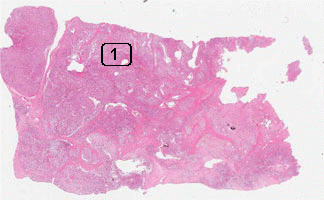
History: This specimen is a
representative section from a 9 cm intramuscular mass excised from the
inner thigh of a 25 year-old man.
Histologic Highlights of this Case:
-
The histopathology of alveolar soft
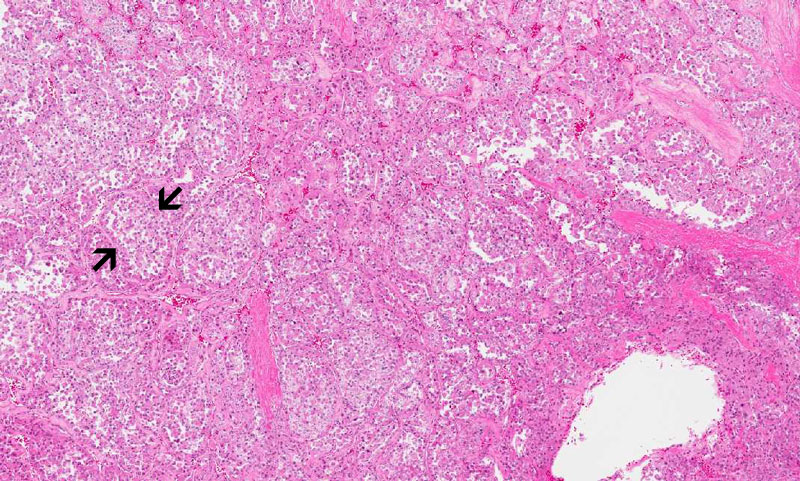
tissue (Area 1) tumor is rather characteristics and stay more or
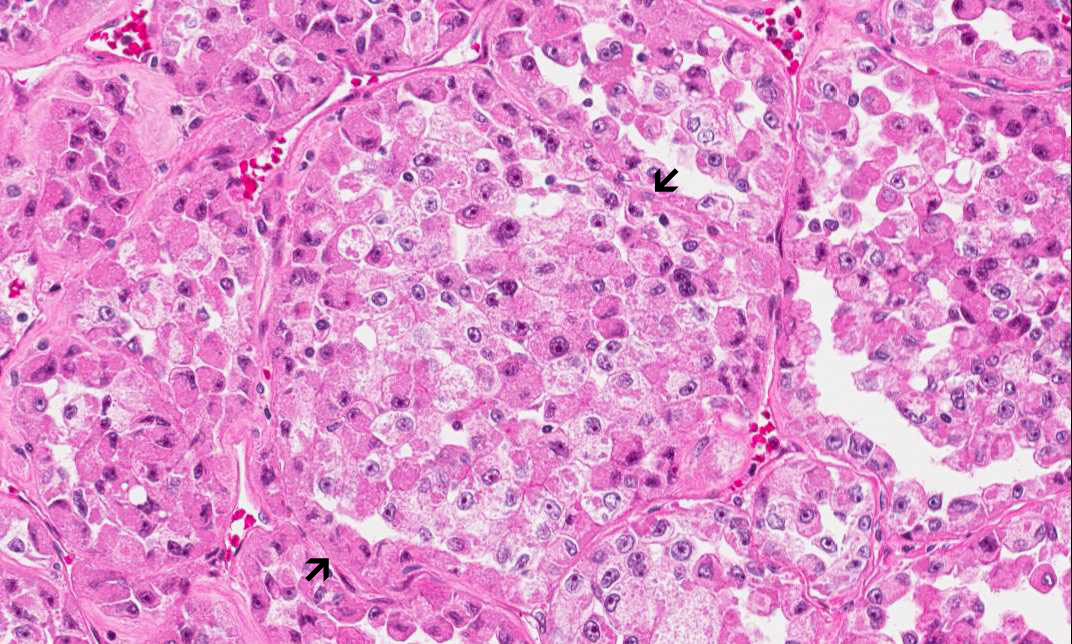
less the same among different tumors. The tumor is composed of nest
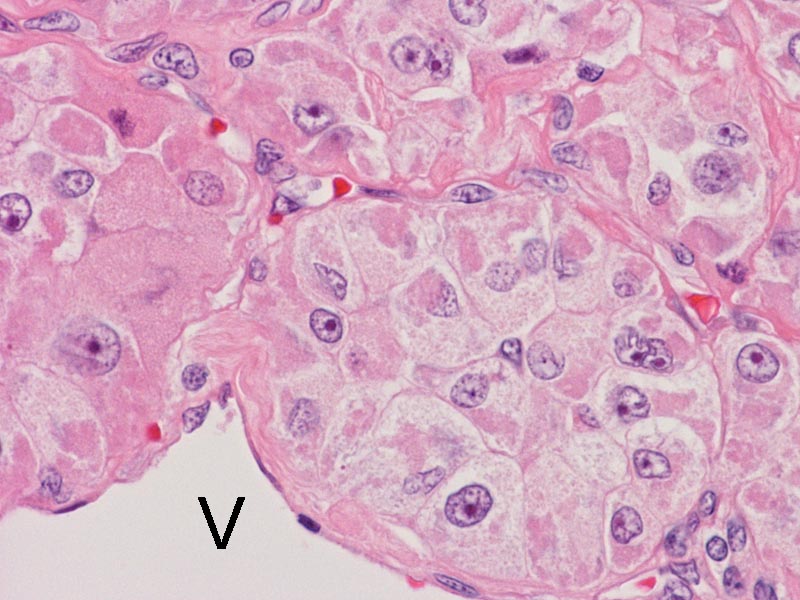
of large polygonal, and rather monotonous cells with a moderate to
large, round nuclei with prominent nuceoli. Intercellular
cytoplasmic membrane is usually distinct. The tumor cells are
separated by thin fibrous septa into small and large nests. Thin
walled sinusoidal channels are present within these fibrous septa.
-
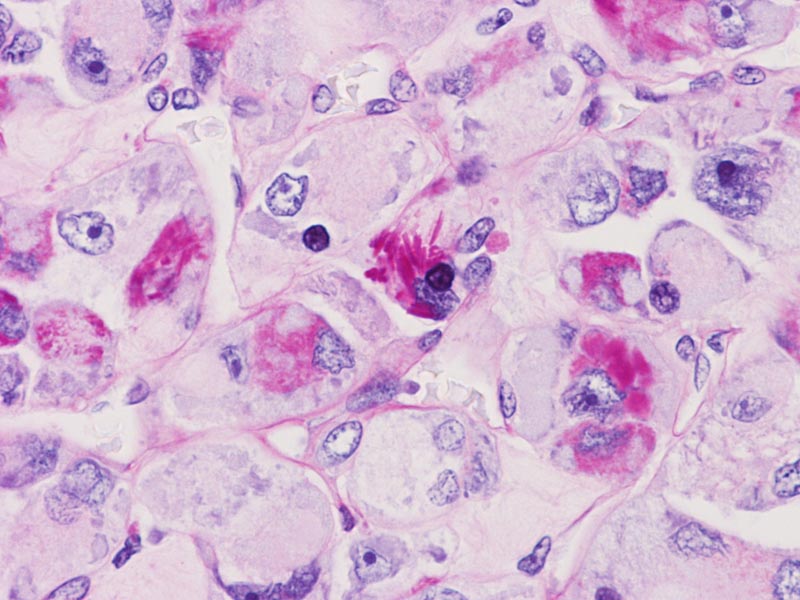
PAS stain with diastases digestion
demonstrated diastase resistant PAS positive material in some but
not all tumor cells. The amount of PAS positive diastase resistant
substance can vary from substantial to absent.
-
Immunohistochemistry for cytokeratin
AE1/AE3, S100 protein, and synaptophysin are negative. Cytokeratin
is useful to screen for metastatic clear cell carcinoma particularly
renal cell carcinoma. S100 and synaptophysin can help to screen for
granular cell tumor and paraganglioma.
Comment:
-
Alveolar soft part sarcoma has been
described in many different locations. The lower eyxtremities are the
most common location in adults and the head and neck region is the
most common in children.
-
Alveolar soft part sarcoma can
metastasize many years after excision and treatment with bone, lung,
liver and central nervous system as the most common sites. In
contrast to other sarcoma, it has a high tendency to metastasize to
the brain. One of the speculation is that alveolar soft part sarcoma
has a strong tendency for vascular invasion.
-
Intracellular rhomboid or rod-shaped
crystalline bodies is an ultrastructural diagnostic feature of
alveolar soft part sarcoma. They can be demonstrated as PAS
positive, diastase resistant rod-shaped substances.
-
Alveolar soft part sarcoma is associated
with der(17)t(X;17)(p11.2q25). This unbalanced translocation forms a
fusion of the TFE3 gene on Xp11.2 with the ASPL gene
and generated a fusion protein that localizes to the nucleus and
functions as an aberrant transcription factor.
Further Reading:
|