 Click thumbnails
to see pictures.
Click thumbnails
to see pictures.
| A 45 year-old Woman with an Enhancing Brain
Mass. June, 2003, Case 306-1. Home Page |
Click thumbnails
to see pictures.
How to approach this case?
Systematic analysis, astute observation, and correlation with clinical and imaging features always help in arriving the correct diagnosis of an uncommon case. Having a high index of suspicion would often bring along rewarding occasions.
In this particular case, the age, sex, and clinical symptom do not really help. The imaging studies discloses a strongly enhancing dural based mass. These features should immediately lead to the question on where this is an intraparenchymal lesion of the brain with dural involvement or whether this is a dural mass that is separated from the brain parenchyma. Identification of a thin layer of cerebral spinal fluid (CSF) in between the mass and the brain parenchyma would clearly confirm that the brain parenchyma is not involved. This type of lesions are often called "extra-axial" lesions as a pathology jargon. The CSF would show up brightly on T2-weighed MRI images. This thin layer of water density surrounding the tumor is often called "CSF-crest". The other important imaging feature that should be seek after is dural tail enhancement. This term refer to enhancement of the dura immediately around the mass. Unfortunately, these information were not available at the time of diagnosis. Bight and homogeneous enhancement is also a common feature of meningiomas.
For the novice, the Classification of Tumors of the Central Nervous System by the World Health Organization (WHO) seems to be difficult to understand. In reality, the differential diagnoses can be formulated by a simple but systematic apprach. Tumors of the central nervous systems can be grossly categorized into 5 major types:
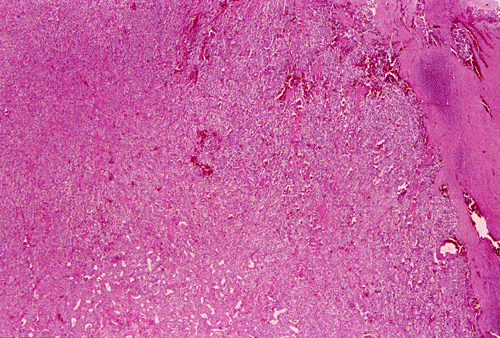
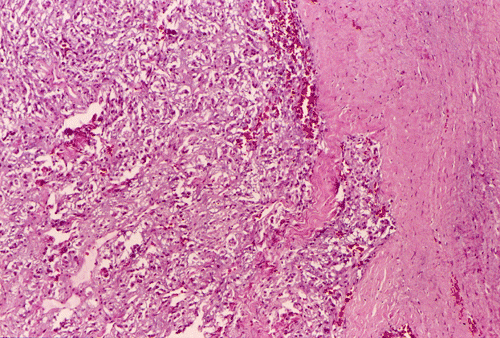
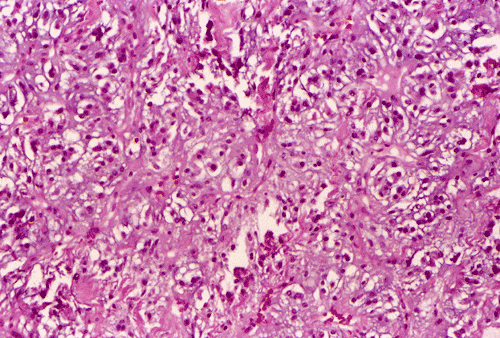
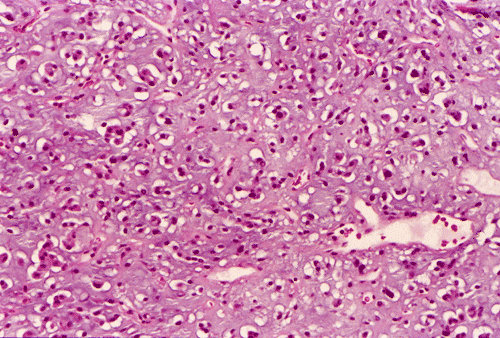
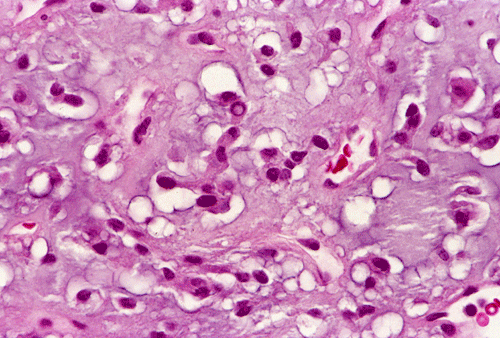
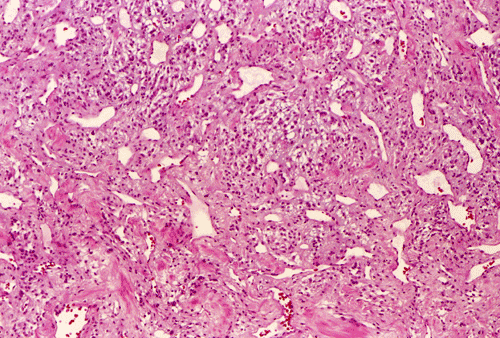
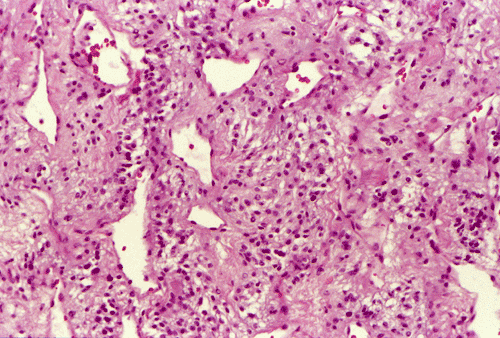
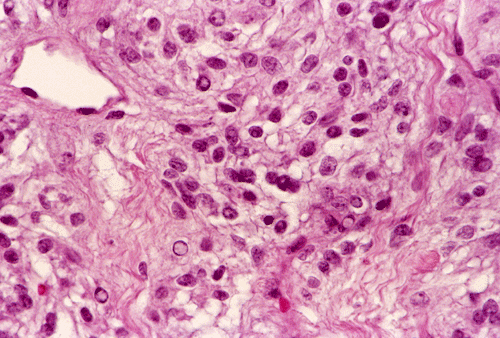
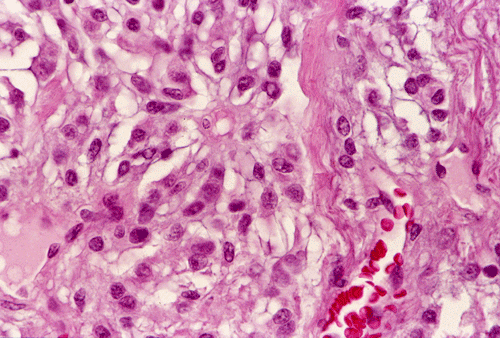
This tumor does not have featues of embryonal differentiation or mature glial/neuronal differentiation. It does not appear to be lymphoma, craniopharyngioma, and germ cell tumor. So, it is most likely a tumor of category 3 or 5. Pathologically, the tumor is clearly a dura based tumor as illustrated in Panel A and B. Dural based metastases are uncommon but are well documented. In most cases, they are metastatic carcinoma or melanoma. The morphology of this cases lack features of melanoma (such as large and eosinophilic nucleoli). It does not form cell nests, a feature that is common in metastatic carcinoma. Furthermore, meningioma cells tend to be far less pleomorphic than carcinoma cells or melanoma cells in most circumference. If in doubt, immunohistochemical markers such as HMB-45 and S100 can be used to rule out melanoma. Immunohistochemistry for cytokeratin can also be used to rule out metastatic carcinoma. Honestly, the morphology of this case does not suggest either of these diagnosis.
Please go back to the discussion to see the pathologic features and differential diagnosis of this case.