
| A 48 year-old Woman with a Mass in Her Thigh. June, 2003, Case 307-2. Home Page |
Mirela Stancu, M.D.1 and Kar-Ming Fung, M.D., Ph.D.2 Last update on July 30, 2003.
1 Department of Pathology, Roger William Medical Center-University Medical Group, Providence, Rode Island and 2 Department of Pathology, University of Oklahoma Health Science Center, Oklahoma City, Oklahoma.
Clinical information:
The patient was a 48 year-old woman who presented with a 10 cm intramuscular mass in her thigh. Magnetic resonance imaging (MRI) studies suggested a "fatty tumor". A resection yielded the following specimen.
|
|
|
|
|
|
| A. | B. | C. | D. | E. |
|
|
|
|
|
|
| F. | G. | H. | I. |
Gross pathology of the case:
The tumor was a soft mass and the surface was covered by some tan tissue fragments that were grossly consistent with skeletal muscle. The cut surface was translucent and gelatinous. Neither necrosis nor hemorrhage was present.
Histopathology of the case:
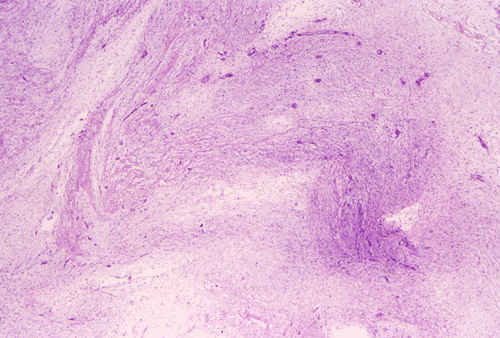
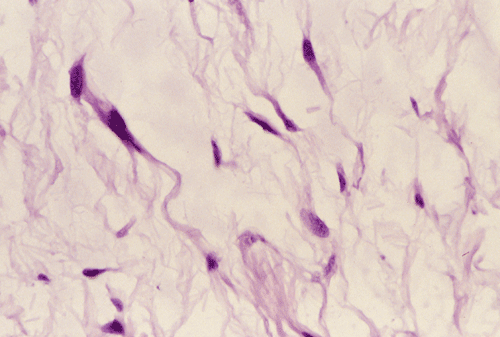
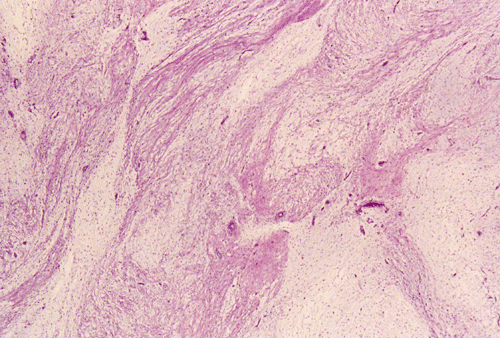
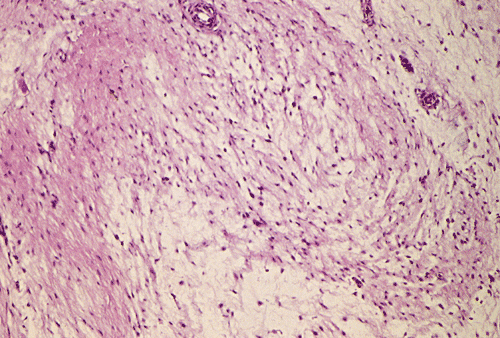
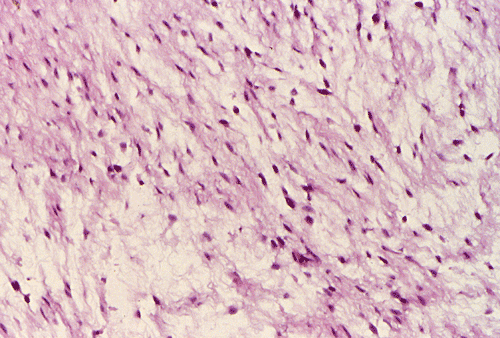
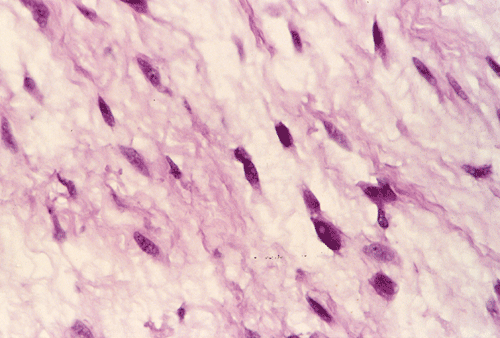
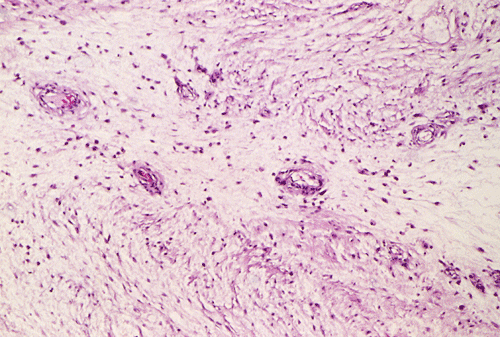
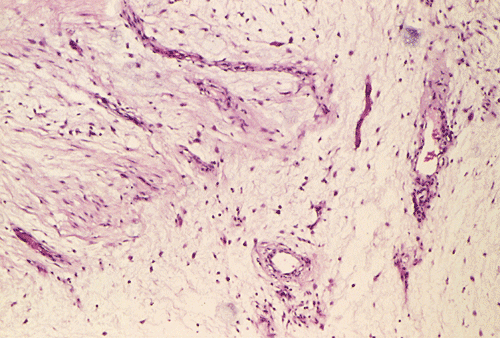
Panel A, B, and C are taken from the one area. Panel D, E, F, and G are taken from another area. Panel H and I are taken from areas with similar histologic features but distinctly separately on the same slide.
On low-magnifaction (Panel A and D), the lesional tissue appears to have generalized myomatous changes. No entrapped skeletal muscle fibers are found. The tumor cells tended to group into areas with variable cellularity that range from low- to, at most, moderate-cellularity. The hypocellular areas (Panel B and C) contain sparsely spaced bland spindle cells in a bluish myxomatous background. The nuclei are elongated and mostly normochromatic. A few hyperchromatic nuclei are present and they are compatible with degenerative atypia (ancient change).
Islands with increased cellularity are present in some areas (Panel D, E, F, and G). These islands comprise about 30-40% of the lesional tissue. The cytologic features of the tumor cells in these areas are almost identical to that of the hypocellular areas except that the cellularity was increased. No mitotic figures are found in these areas. Focal hypervascularity are often found in areas with hypercellularity. No cellular condensation around blood vessels are noted (Panel H and I).
No surrounding muscle is submitted for evaluation of infiltration.
| DIAGNOSIS: Cellular Myxoma (Low-grade myxoid neoplasm with recurrent potential). |
Discussion: General Information Pathology Differential diagnosis
General Information
Intramuscular
myxoma 1,
2 was
brought to attention after a series of 34 cases published by Enzinger in 1965
1.
It is now established that intramuscular myxoma has no tendency toward
recurrence and is cured by local excision. Cellular myxoma, also known as
low-grade myxoid neoplasm with recurrent potential, is a term that has been used
recently to describe a family of myxomatous neoplasm with features in between
intramuscular myxoma and low-grade myxofibrosarcoma
3,
4,
5,
6.
Although these tumors may recur, they do not metastasize. During the short
available period of follow up in two of the recent studies, the rate of
recurrence of these tumors is low
3,
4.
It is important, therefore, to distinguish intramuscular myxoma and its cellular
variant from sarcomas with myxomatous features. Myxoid tumors of soft tissue, in
fact, comprise of a heterogeneous family of neoplasm with significant different
biological potential, ranging from benign to malignant
7.
Intramuscular
myxoma occurs primarily in adults between 40-70 years of age. It is extremely
rare in young adults and almost unknown in children and adolesence. Female are
slightly more affected than male although a female predilection has been
documented in one study
8.
Almost half of the cases occur in the large muscles of thigh, most of the
remaining cases occur in the buttock and a small number of them occur in the
head and neck region, lower leg, and the chest wall
9.
Cellular myxomas do not seem to have different demographic characteristics and
location of occurrence from that of intramuscular myxoma
3,
4.
The
most common clinical manifestation is a slow growing asymptomatic mass in the
thigh. There is no close relationship between the size and clinical duration.
Dull pain is noted in a small proportion of patients. Although most
intramuscular myxomas are solitary, multiple tumors, often arising from the same
region, have been well described. Mazabraud's
syndrome refers to an association between fibrous dysplasia and multiple
intramuscular myxoma
10,
11.
The fibrous dysplasia occurs during the growth period of the bone and the
intramuscular myxoma tend to occur in adult life and could occur 20 to 30 years
after the fibrous dysplasia.
Although
myxomas of the jaws are well-documented entities, these tumors are regarded as
odotogenic origin because no similar tumors occur in other parts of the
skeleton. In contrast to intramuscular myxoma, myxomas of the jaws tend to occur
in young patients and, less commonly, children. They are also locally invasive
12.
Ganglion cysts are myxomatous lesions that have been described in bone
13,
14.
[Click here to see a case of myxoma of
the jaws]
Intramuscular myxoma
The macroscopic pathology is fairly typical and with little variation from case to case. Some of the tumors are entirely surrounded by skeletal muscle while others are attached to the fascia. Most tumors are well-circumscribed, oval or globular, and have a gray-white translucent to gelatinous cut surface. Small fluid-filled cyst may be seen. Most tumors are 5 to10 cm in diameter 2. Cellular myxoma do not seem to deviate from this theme. However, not all deep-seated tumors appear to be entirely intramuscular 3.
Similar
to the macroscopic pathology, histopathologic features between different
intramuscular myxomas are very similar. The tumor proper is composed of
myxomatous, hypocellular proliferations with sparse collagen fibers and
vascularity. Fluid-filled cystic spaces may be encountered but is neither a
fixed nor prominent feature. The tumor cells are elongate, spindle, with
delicate and scanty amphophilic cytoplasm. The nuclei are bland, small and
hyperchromatic, elongated, and without prominent nucleoli. Occasional enlarged
and slightly hyperchromatic nuclei consistent with degenerative atypia (ancient
changes) may be seen. Otherwise, there is little pleomorphim and no
multinucleated giant cells are present. Mitotic figures are typically absent.
Foamy macrophages may be scattered within the tumors and should not be mistaken
as lipoblasts. All the cellular elements collagen fibers appear to be suspended
within a large amount of mucoid substance that can be stained positive for
alcian blue, mucicarmine, and colloidal iron stain. Some macrophage-like cells
mimicking lipoblasts are present.. A true capsule is usually
lacking but delicate fibrous membranes are frequently found at the interface.
Entrapped and atrophic skeletal fibers at the interface may be misinterpreted as
features of rhabdomyosarcoma. Entrapped adipose cells may also be misinterpreted
as atypical lipoblasts.
Immunohistochemistry, the cells are immunoreactive for vimentin and rare cells may be positive for actin. In contrast to lipoblasts, they are not immunoreactive for S-100 protein. The macrophage-like cells may contain droplets that are stained by oil red O.
Cellular
myxoma
The great majority of cellular myxomas have good circumscription
macroscopically. However, focal infiltration in noted in 37 out of 38 cases in
one study
3. The majority of cellular myxomas contain areas of classic
intramuscular myxoma. In contrast to classic intramuscular myxomas, areas with hypercellularity
and hypervascularity are present and these areas would comprise 20-90% of
the lesion; these areas can be diffuse or focal in distribution. The cytologic
features in hypercellular areas, however, are similar if not identical to the
cells in classic intrmuscular myxoma. Characteristically, there is no increase
in pleomorphism or mitotic activities. The increased vascularity is composed of
capillary sized blood vessels and has no cellular condensation around blood
vessels
3,
4.
Differential diagnosis
Myxomatous changes are common among mesenchymal tumors. The list of differential diagnosis is long. However, the differentiation is usually not difficult if one is familiar with the clinical and histopathologic features.
Juxta-articular myxoma is
a myxomatous tumor that arises in the joint capsule or in close proximity of a
joint. Histologically, they are not distinguishable from intramuscular myxoma or
cellular myxoma. The distinction is purely based on clinical grounds.
Juxta-articular myxomas, however, are more prone to recur
15.
Low-grade myxofibrosarcoma
is an indolent mesenchymal tumor with potential for local recurrence,
progression to high-grade tumor with an associated risk of distant metastasis in
30-50% of cases, and has histologic features similar to cellular myxoma.
However, low-grade myxofibrosarcoma occurs more commonly in older patients,
contains the classical curvilinear vascular architecture that is often, but not
always, associated with perivascular cellular condensation. They also have
increased cytologic atypia and hyperchromatic nuclei
16.
Myxoid liposarcoma
is the most common liposarcoma and accounts roughly for all liposarcomas. Their
clinical features overlap with that of cellular myxomas. Myxoid liposarcomas are
multinodular, hypocellular tumors that characteristically harbor a lattice of
delicate, branching, narrow, thin-walled capillary like vascular network with
little variation in the diameter of the vessels. Myxoid liposarcoma contains
cells consistent with varying degrees of adipocytic differentiations.
Characteristic lipoblasts, featured by cytoplasmic lipid droplets that indent
the nuclei, are often encountered adjacent to these vessels and in more cellular
areas
17,
18.
In most cases, the t(12:16)(q13:p11) chromosomal translocation is present
17.
Neurofibroma
tends to occur in a location that is far from the central nervous system and
they are seen more often in the extremities. Other than those associated with
neurofibromatosis 1, many of them are solitary dermal or subcutaneous tumors
that occur in adults. Characteristically, thin threads of collagens suspending
within a myxoid background are present. Demonstration of entrapped axons by
immunohistochemistry for neurofilament proteins as well as patchy but
unambiguous immunoreactivity for S-100 protein are helpful features to
distinguish them from intramuscular myxomas and cellular myxomas. Malignant
peripheral nerve sheath tumors (MPNST) typically contain areas with
hypercellularity and pleomorphism that would not allow them to be confused with
cellular myxoma.
Myxoid malignant fibrous histiocytoma (MFH) is essentially MFH with
myxomatous change. Areas with typical features of MFH are almost always present
and, in many cases, abundant. In addition, the transition between the myxoid
areas and areas of classic MFH is abrupt.
Aggressive angiomyxoma
is locally aggressive tumors with recurrence in about half of the cases and the
age of occurrence overlap with that of cellular myxoma. In contrast to the
predominantly intramuscular origin of myxomas, aggressive angiomyxomas occurs
almost exclusively in female and are limited to the perineal and pelvic regions.
Histologically, aggressive angiomyxomas have infiltrative margins. They
have loose and hypocellular myxoid stroma that is positive for alcian blue
stain. The tumor cells are evenly distributed monotonous small round, spindle or
stellate cells. They have non-arborizing, thin-walled walled ectactic blood
vessels and small thick walled blood vessels with characteristic symmetrical and
circumferential condensation of stromal cells around them. Mast cells &
extravasated red cells in stroma are common.
Angiomyofibroblastoma shares
with aggressive angiomyxomas a similar age of occurrence, almost exclusive
occurrence in female, and occurring predominantly in the vulva, and rarely the
scrotum. Unlike aggressive angiomyxomas, angiomyofibroblastomas are superficial
and non-infiltrating tumors that do not recur. They
have collagenous to strikingly edematous stroma with alternating hyper- and
hypocellular regions containing spindle to round to plasmacytoid cells. There is
a rich vascularization with thin-walled blood vessels and the vascularity
somewhat correlates with cellularity. There are cellular aggregates or masses
around blood vessels. Cells around blood vessels may have an myoepithelial
appearance. The background is edematous in nature and is negative for alcian
blue stain.
Reference:
Enzinger
FM. Intramuscular myxoma. A review and follow-up of 34 cases. Am J Clin
Pathol 1965 43:104-113.
Weiss
SW, Goldblum JR. Benign soft tissue tumors and pseudotumors of miscellaneous
type. In Enzinger and Weiss’s Soft Tissue Tumors. 4th
edt.,Mosby, St. Louis 2001.
van
Roggen JF, McMenamin ME, Fletcher CD
Cellular myxoma of soft tissue: a clinicopathological study of 38
cases confirming indolent clinical behaviour.
Histopathology.
2001 39:287-97.
Nielsen
GP, O'Connell JX, Rosenberg AE.
Intramuscular myxoma: a clinicopathologic study of 51 cases with
emphasis on hypercellular and hypervascular variants. Am
J Surg Pathol.
1998 22(:1222-7.
Fletcher
CDM. Soft tissue tumors. In Diagnostic Histopathology of Tumors. Eds.
Fletcher CDM. 2nd edt. Churchill Livingstone, London 2000.
Catroppo
JF, Olesnicky L, Ringer P, Goldenkranz R, Casas V, Wright T.
Intramuscular low-grade myxoid neoplasm with recurrent potential
(cellular myxoma) of the lower extremity: case report with cytohistologic
correlation and review of the literature. Diagn
Cytopathol.
2002 26:301-5.
Allen
PW.
Myxoma is not a single entity: a review of the concept of myxoma. Ann
Diagn Pathol.
2000 4:99-123.
Hashimoto
H, Tsuneyoshi M, Daimaru Y, Enjoji M, Shinohara N.
Intramuscular myxoma. A clinicopathologic, immunohistochemical, and
electron microscopic study. Cancer.
1986 58:740-7.
Lattes
R, Enzinger FM: Soft Tissue Tumors. Proceedings of the thirty-ninth Anatomic
Pathology Slide Seminar. American Society of Clinical Pathology. 1973
Wirth WA, Leavitt D, Enzinger FM. Multiple intramuscular myxomas. Another extraskeletal manifestation of fibrous dysplasia. Cancer. 1971 27:1167-73.
Court-Payen
M, Ingemann Jensen L, Bjerregaard B, Schwarz Lausten G, Skjoldbye B.
Intramuscular myxoma and fibrous dysplasia of bone--Mazabraud's
syndrome. A case report. Acta
Radiol. 1997
38:368-71.
Barker
BF.
Odontogenic myxoma. Semin Diagn Pathol. 1999 16:297-301.
Bauer
TW, Dorfman HD.
Intraosseous
ganglion. A clinicopathologic study of 11 cases. Am J Surg Pathol 1982
6:207-13.
Sim
FH, Dahlin DC.
Ganglion cysts of bone. Mayo Clin Proc 1971 46:484-8.
Meis
JM, Enzinger FM.
Juxta-articular
myxoma: a clinical and pathologic study of 65 cases.
Hum Pathol.
1992 23:639-46.
Mentzel
T, Calonje E, Wadden C, Camplejohn RS, Beham A, Smith MA, Fletcher CD.
Myxofibrosarcoma.
Clinicopathologic analysis of 75 cases with emphasis on the low-grade
variant. Am J
Surg Pathol.
1996 20:391-405.
Kilpatrick
SE, Doyon J, Choong PF, Sim FH, Nascimento AG. Kilpatrick SE, Doyon J,
Choong PFM The
clinicopathologic spectrum of myxoid and round cell liposarcoma. A study of
95 cases. Cancer.
1996 77:1450-8.