| A 65 year-old Woman with
a Red Nodules on Her Breast. October, 2003, Case 310-2. Home Page |
Robyn M. Potts, M.D.1, Mirela Stancu, M.D.2 Last update on October 30, 2003.
1 Department of Pathology, University of Oklahoma Health Sciences Center, Oklahoma City, Oklahoma.2 Department of Pathology, Roger William Medical Center-University Medical Group, Providence Rode Island
Initially provided clinical information: The patient was a 65 year-old woman who presented with red nodules and yellow patches on her breast.
Additional clinical information: The patient had a history of breast carcinoma 6 years ago. She was treated by surgery and radiation therapy. This piece of information was withheld to increase the challenge level of this case.
|
|
|
|
|
|
|
| A. | B. | C. | D. | E. | |
|
|
|
|
|
||
| F. | G. | H. | I. |
Pathology of the case:
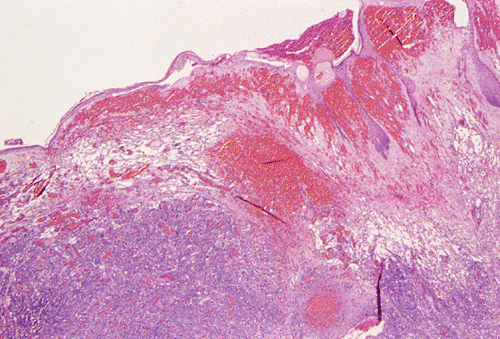
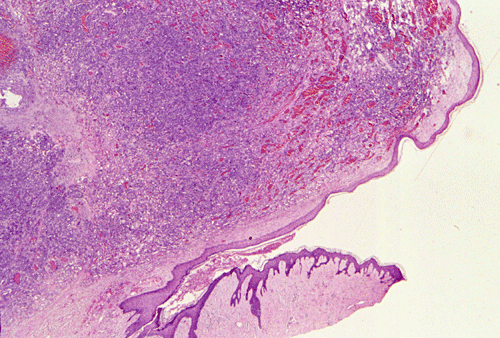
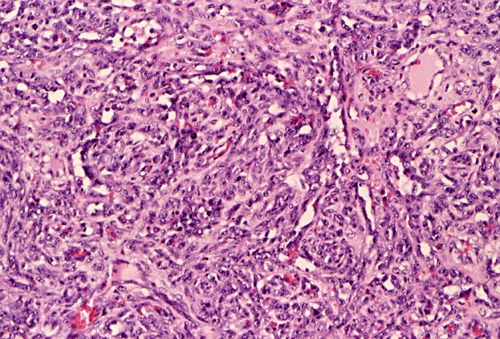
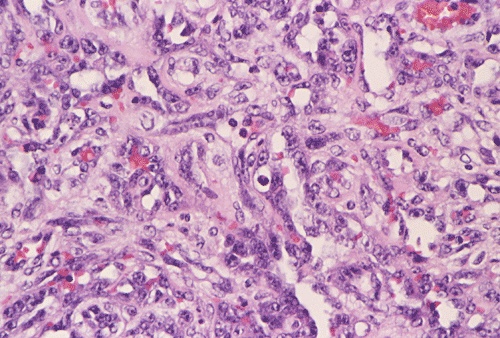
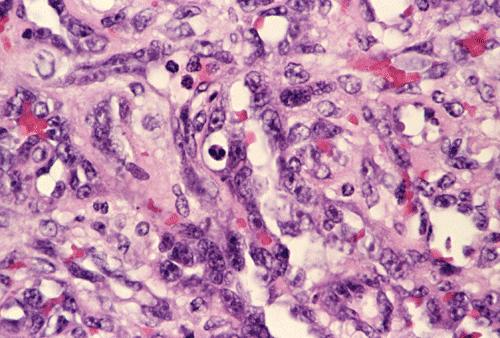
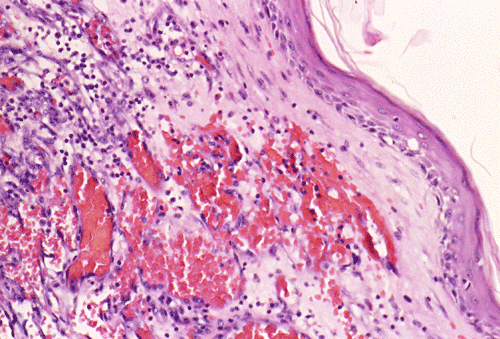
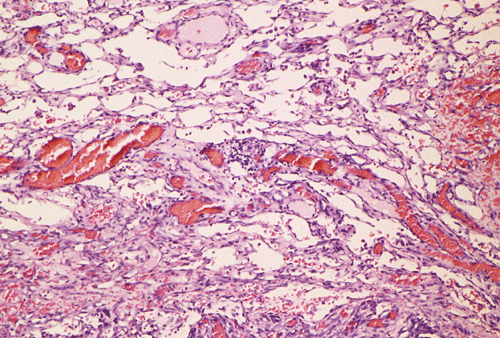
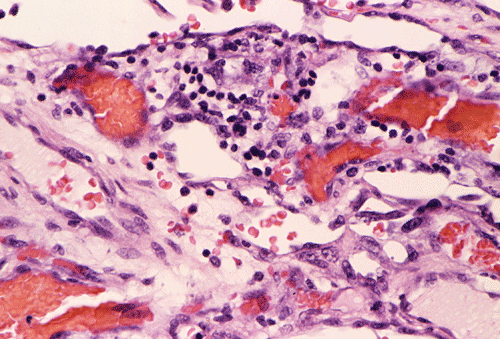
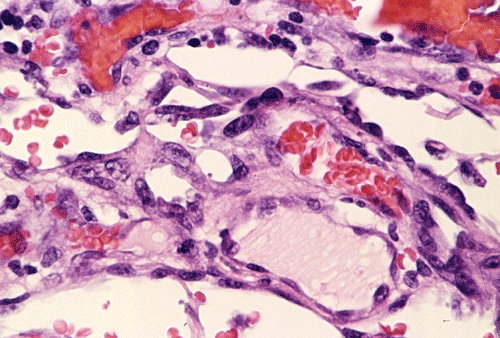
Panel A, B and F are taken from the dermal-epidermal junction. Panel B, C, D, and E are taken from the same area. Panel F, G, H, and I are taken from the same area
The tumor appears to be centered on the dermis and does not involve breast parenchyma in the sections examined A (not shown). On low-magnification (Panel A, B and F), the lesional tissue is a highly cellular and vascular tumor in the dermis. The large areas of hemorrhage ("blood-lake") and dilated vascular channels (Panel A, and F) probably correspond to the "red nodules and yellow patches" on physical examination. Although the tumor extends deeply into the subcutaneous tissue (not shown here), there is no evidence of invasion in to the epidermal layer (Panel A, B and F). The histology of this tumor varies in different areas. In some areas, it appears as a densely packed spindle cell tumor with exuberant and irregular and anastomosing vascular channels (Panel B, C, and D). The endothelial cells protrudes into the vascular channels and had enlarged, hyperchromatic nuclei with prominent nucleli. In another area, the lesion contains numerous ectactic and anastomosing vascular channels (Panel F, G, H, and I). Pleomorphic changes are also prominent in the vascular cells in these areas. On immunohistochemistry, the tumor cells are immunoreactive for CD31, CD34 (not shown).
| DIAGNOSIS: Angiosarcoma of the breast associated with radiation therapy. |
Discussion: General Information Pathology Differential diagnosis
General Information
Angiosarcoma
of the breast is a rare and highly lethal neoplasm accounting for less than 0.1%
of malignant breast tumors 1. Although
these tumors may arise de novo in the breast, there is increased
incidence in patients who have had radiation therapy and in patients with
chronic lymphedema
2.
Stewart-Treves
syndrome refers to the sequence of lymphangiosarcoma occurring as a late
complication of severe lymphedema of the arm after excision of the lymph nodes,
usually in radical mastectomy. Thus,
in patients treated for breast carcinoma with radiation therapy and mastectomy,
which is often complicated by chronic lymphedema, the incidence of angiosarcoma
is estimated to be as high as 0.3% to 0.4%
3,
4.
Data from the National Cancer Institute show a relative risk of developing
angiosarcoma after lumpectomy, axillary node dissection, and radiation to be
15.9
5.
Clearly, the recognition of the development of angiosarcoma in this population
of patients is important for both clinicians and pathologists
6,
7,
8,
9,
10.
The
clinical presentation is highly varied.
Angiosarcoma can involve the overlying skin and/or the breast parenchyma
itself.
The initial finding is typically a painless erythematous, “bruise-like,
or violaceous discoloration of the skin, which may be multifocal.
Often there is a delay in diagnosis, because the lesion is attributed to
minor trauma.
Only after the lesion persists and/or grows is the lesion biopsied.
Palpable lesions are more often visible by mammography than nonpalpable
lesions and usually reveal areas of high and low echogenicity on ultrasound
3,
11.
MRI of the breast has been increasingly touted as the breast imaging modality of
choice in cases of angiosarcoma
12,
13.
The lesions are markedly enhancing with low T1-weighed signal and high
T2-weighed signal.
Nevertheless, biopsy or fine needle aspiration of suspicious lesions is
still necessary for confirming the diagnosis.
Angiosarcomas
are tumors with features recapitulating the endothelial cells.
This term applies to all sarcomas with endothelial differentiation
regardless of their relationship to blood vessels and lymphatics
1.
The macroscopic appearance of angiosarcoma of the breast is typically that of an
ill-defined spongy hemorrhagic tumor.
The tumors range in size from 1 cm to up to 20 cm and average about 5 cm.
A rim of hemorrhage often surrounds the tumor.
They are usually deep-seated masses but spread to involve the skin
1,
3.
The microscopic picture of angiosarcoma of the breast is not unlike angiosarcoma found elsewhere in the body. However, it is extremely important to note that angisarcoma of the breast can have bland cytologic features. Any vascular lesion in the breast must, therefore, be handled with extreme care.
The
most distinctive histologic feature in angiosarcoma is the formation of
irregular, anastomizing vascular channels lined by plump, hyperchromatic, and
anaplastic endothelial cells. These vascular channels proliferate and infiltrate
the glandular breast tissue, fat and subcutaneous tissue.
Low-grade lesions usually have only rare mitotic figures. Increased
mitotic activity in an otherwise low-grade angiosarcoma may suggest the presence
of a high-grade lesion in adjacent tissue.
Intermediate-grade lesions have an increased amount of endothelial
tufting and papillary formations within the irregular vascular channels and
these are associated with increased numbers of mitoses. While the anastomizing
vascular channels are characteristic of areas with low- or intermediate- grade
cytologic features, solid sheets of spindle cells with minute, slit-like
channels not filled by red blood cells are common in high-grade areas. In
addition, high-grade angiosarcoma are marked by numerous mitotic figures in all
parts of the tumor, the presence of “blood lakes”, and necrosis.
In most tumors the high-grade portion comprises the core of the
tumor and the better-differentiated portion forms the infiltrative border of the
lesion 3.
Immunohistochemical
findings in angiosarcoma include reactivity for endothelial markers like CD31
and CD34 as well as staining for factor VIII related antigen.
Epitheliod variants of high-grade angiosarcoma can be differentiated from
carcinoma with these immunohistochemical markers
17.
Ultrastructurally,
Weibel-Palade bodies have been described, however they may not be found in the
high-grade angiosarcomas 1.
Differential diagnosis
While
intermediate- and high-grade angiosarcoma are clearly malignant and do not
usually pose any diagnostic problem, low grade angiosarcomas are readily
mistaken for benign hemangioma.
Benign hemangiomas are typically less than 2 cm in size while most
angiosarcomas are larger.
The border of a benign lesion is well circumscribed, while the malignant
lesions tend to have infiltrating borders.
Infiltration into breast parenchyma and expansion of the lobules is the
hallmark of angiosarcomas.
Benign hemangiomas do not invade breast parenchyma.
Angiolipoma
features intermingling vessles and fat lobules.
Angiolipoma may be mistaken for invasion of fat by an angiosarcoma.
This is particularly problematic if the angiolipoma is particularly
cellular
18.
They key to differentiating these two entities is the recognition of
microthombi within the vessels of angiolipoma.
Pseudoangiomatous
stromal hyperplasia (PASH) is best differentiated from angiosarcoma by the lack
of malignant cytological features and by immunohistochemical staining.
The spindle cells in PASH stain positively with smooth muscle actin and
desmin.
They may be reactive with CD34 but do not stain with factor VIII related
antigen
19.
Papillary
endothelial hyperplasia as described by Branton et al. is the “great imposter for angiosarcoma”
20.
In contrast to angiosarcoma, papillary endothelial hyperplasia are well
circumscribed, they are found within a vessel or association with a thrombus,
and lack cytological atypia or areas of solid growth.
Reference:
Weiss, SW and Goldblum, JR.
Soft Tissue Tumors, 4th ed. Mosby, Inc, St. Louis
Missouri. pp. 933
Azurdia
RM, Guerin DM, Verbov JL. Chronic lymphoedema and angiosarcoma. Clin
Exp Dermatol. 1999;24(4):270-2.
Rosen PP.
Breast Pathology. 2nd
ed. Lippincott, Williams and Wilkins, New York, NY pp.830.
Karlsson
P, Holmberg E, Samuelsson A, Johansson KA, Wallgren A. Soft tissue
sarcoma after treatment for breast cancer--a Swedish population-based study.
Eur J Cancer. 1998;34:2068-75.
Monroe
AT, Feigenberg SJ, Mendenhall NP. Angiosarcoma after breast-conserving
therapy. Cancer. 2003;97:1832-40.
Cozen
W, Bernstein L, Wang F, Press MF, Mack TM. The risk of angiosarcoma
following primary breast cancer. Br J Cancer. 1999;81:532-6.
Rao
J, Dekoven JG, Beatty JD, Jones G. Cutaneous angiosarcoma as a delayed
complication of radiation therapy for carcinoma of the breast. J Am Acad
Dermatol. 2003;49:532-8.
Mermershtain
W, Cohen AD, Koretz M, Cohen Y. Cutaneous angiosarcoma of breast after
lumpectomy, axillary lymph node dissection, and radiotherapy for primary
breast carcinoma: case report and review of the literature. Am J Clin
Oncol. 2002;25(6):597-8.
Huang
J, Mackillop WJ. Increased risk of soft tissue sarcoma after
radiotherapy in women with breast carcinoma. Cancer. 2001;92:172-80.
Chahin
F, Paramesh A, Dwivedi A, Peralta R, O'Malley B, Washington T, Lakra Y.
Angiosarcoma of the breast following breast preservation therapy and local
radiation therapy for breast cancer. Breast J. 2001;7:120-3.
Yang
WT, Muttarak M, Ho LW. Nonmammary malignancies of the breast:
ultrasound, CT, and MRI. Semin Ultrasound CT MR. 2000;21(5):375-94.
Murakam
S, Nagano H, Okubo K, Sakata H, Tsuji Y, Ishiguro T, Hirayama R, Amanuma M,
Hirose T. Angiosarcoma of the breast: report of a case and its findings
of MRI. Breast Cancer. 2001;8:254-8.
Fant
J, Grant M, May S, Talaasen L, Watkins D. Angiosarcoma of the breast:
mammographic, clinical, and pathologic correlation. Breast J. 203
May-Jun;9(3):252-3.
Blanchard
DK, Reynolds CA, Grant CS, Donohue JH. Primary nonphylloides breast
sarcomas. Am J Surg. 2003;186:359-61.
Zelek
L, Llombart-Cussac A, Terrier P, Pivot X, Guinebretiere JM, Le Pechoux C,
Tursz T, Rochard F, Spielmann M, Le Cesne A. Prognostic factors in
primary breast sarcomas: a series of patients with long-term follow-up. J
Clin Oncol. 2003;21:2583-8.
Georgiannos
SN, Sheaff M. Angiosarcoma of the breast: a 30 year perspective with an
optimistic outlook. Br J Plast Surg. 2003;56:129-34.
Farina
MC, Casado V, Renedo G, Estevez L, Martin L, Requena L. Epithelioid
angiosarcoma of the breast involving the skin: a highly aggressive neoplasm
readily mistaken for mammary carcinoma. J Cutan Pathol.
2003;30:152-6.
Kahng
HC, Chin NW, Opitz LM, Pahuja M, Goldberg SL. Cellular angiolipoma of
the breast: immunohistochemical study and review of the literature. Breast
J. 2002;8:47-9.
Leon
ME, Leon MA, Ahuja J, Garcia FU. Nodular myofibroblastic stromal
hyperplasia of the mammary gland as an accurate name for pseudoangiomatous
stromal hyperplasia of the mammary gland. Breast J. 2002;8:290-3.
Branton
PA, Lininger R, Tavassoli FA. Papillary endothelial hyperplasia of the
breast: the great impostor for angiosarcoma: a clinicopathologic review of
17 cases. Int J Surg Pathol. 2003;11:83-7.
Requena
L, Kutzner H, Mentzel T, Duran R, Rodriguez-Peralto JL. Benign vascular
proliferations in irradiated skin. Am J Surg Pathol. 2002;26:328-37.
Guillou
L, Fletcher CD. Benign lymphangioendothelioma (acquired progressive
lymphangioma): a lesion not to be confused with well-differentiated
angiosarcoma and patch stage Kaposi's sarcoma: clinicopathologic analysis of
a series. Am J Surg Pathol. 2000;24:1047-57.